The following poster summarises all the work the Fairlamb group partakes in. A more in depth description can be found below the image.
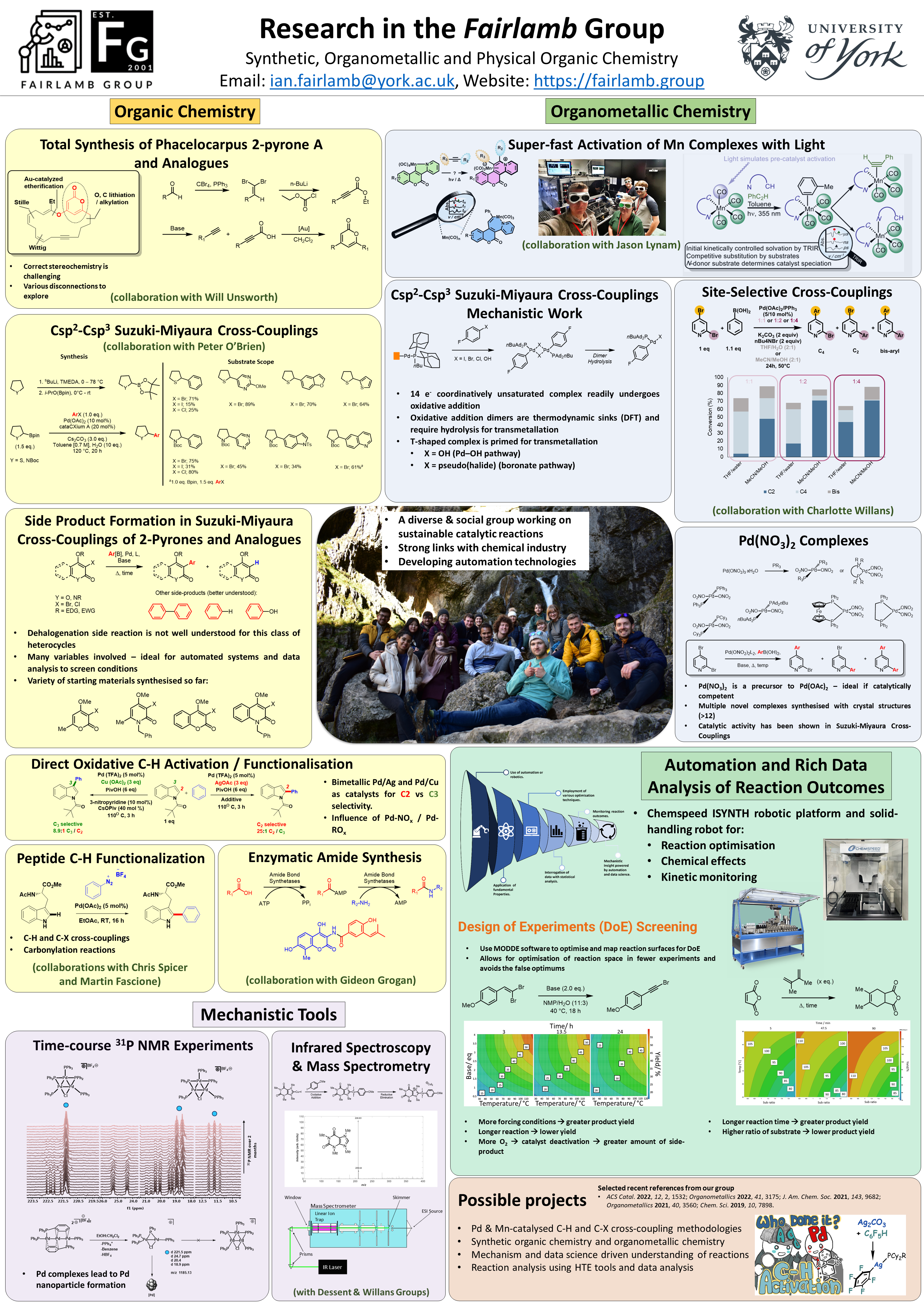
The above poster outlines all the work the Fairlamb group conducts, including work with other Academics which Prof. Fairlamb co-supervises/co-manages. The Fairlamb group researches organic chemistry: Side Product Formation in Suzuki-Miyaura Cross-Couplings of 2-Pyrones and Analogues and Direct Oxidative C-H Activation / Functionalisations. More organic chemistry projects involve Dr. Will Unsworth looking at the total synthesis of Phacelocarpus 2-pyrone A and analogues and Prof. Peter O’Brien researching the synthesis of various boronic acid analogues used during Csp²-Csp³ Suzuki-Miyaura cross-couplings and applying to large substrate scopes. Further research projects in bio-organic chemistry field with Prof. Gideon Grogan look at peptide C-H functionalisation, and Dr. Chris Spicer, and Dr Martin Fascione with enzymatic amide synthesis.
Organometallic chemistry is the main focus of the Fairlamb group looking at: The mechanisms behind Csp²-Csp³ Suzuki-Miyaura cross-couplings, site-selective cross-couplings (collaborating with Dr. Charlotte Willans), and designing new Pd(NO3)2 catalysts for screening in a variety of cross-coupling reactions. Collaborations with Prof. Jason Lynam look at the mechanisms of Mn2CO10 based catalysts using ultra-fast time resolved infrared spectroscopy.
Prof. Fairlamb collaborates with Prof. Caroline Dessent and Dr. Charlotte Willans in the development of combined mass spectrometry and infrared spectroscopy as a dual analysis technique of mass fragments. The Fairlamb group has their own automation lab (including a Chemspeed Swing platform, Crystal Powderdose, flow systems, and other automation equipment) which develops new automation techniques for high-throughput screening of catalytic reaction conditions, substrates, ligands, and bases to generate large data sets to assist with mechanistic understanding of cross-coupling reactions.
Prof. Fairlamb has given a webinar about work using the Chemspeed Robotics Platform here at the University of York. Titled:
Complexity in Pd–Catalyzed Cross-Couplings: Uncovering Competing Catalytic Cycles Through High Throughput Experimentation and Rich Data Analysis of Reaction Outcomes.
Prof. Ian Fairlamb will describe how the Chemspeed ISYNTH platform was used, in tandem with other techniques and methods, to examine a complicated Pd-catalyzed cross-coupling involving the reaction of two molecules of a 2-bromo-benzamide derivative to give an N-phenyl phenanthridinone product.
Please use the following link to view the webinar: link to Chemspeed Webinar.
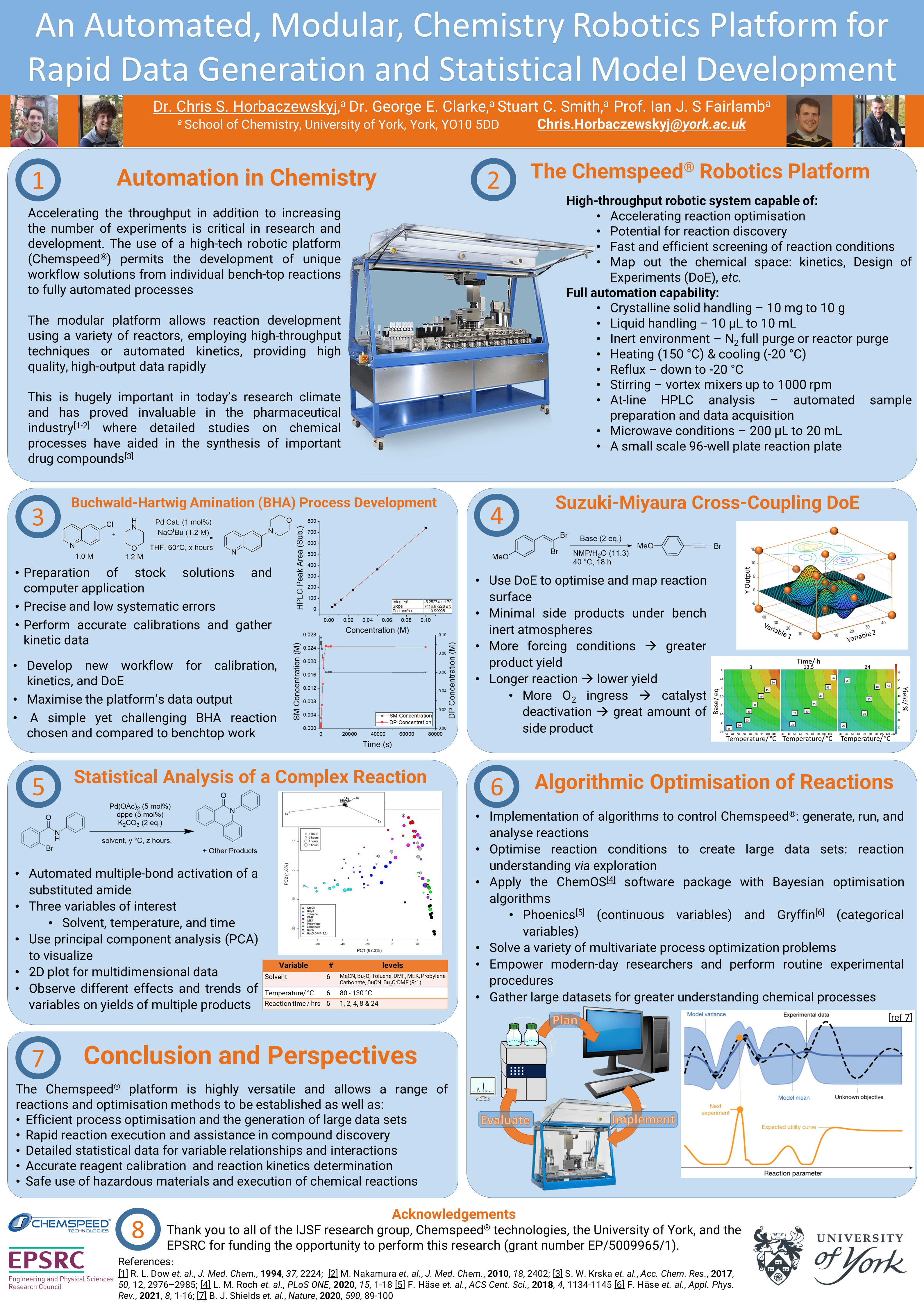
The following poster was showcased at the 2022 YorRobots Industry Meeting.
 fairlamb.group