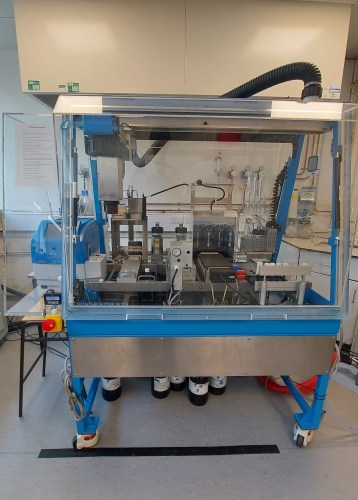

Accelerating the throughput and increasing the number of experiments is a critical factor in research and development. The Fairlamb group is employing automation for chemical synthesis and mechanistic insights using a Chemspeed robotics platform for high throughput experimentation, reaction kinetics and reaction conditions screening. The use of this platform is to assist in the modernisation of the way chemical reactions are screened and evaluated. The automated platform enables the Fairlamb group to increase their number of experiments to find faster and more effective solutions to demanding challenges in the area of synthetic chemistry and catalysis. Furthermore, the higher output can leverage the success rate in finding new, greener and cleaner synthetic methods to valuable chemical intermediates, which are important drivers in research, not only for academics but also in industry. The platform can also be modularised and upgraded to assist the users needs. The group is looking at integrating algorithms into the platform which will allow it to plan, perform and evaluate its own reactions as a closed-loop system.
The high-tech robotic equipment which is designed and built by Chemspeed, is housed within the Chemistry Department and is accessible to many groups throughout the University. Dr. Chris Horbaczewskyj (our Technical Expert) is working to maintain the robot as well as performing and assisting work within the group and work with internal collaborators. Chris interacts closely with the research groups in York to identify mutually beneficial collaborative opportunities, which have the potential to transform productivity and diversify the portfolio of research projects being carried out at York.
The Fairlamb group is part of a wider initiative, YorRobots – associated with the Institute for Safe Autonomy and RoboStar, which aims to bring together researchers and practitioners with an interest in robotics and autonomous systems and their applications. YorRobots is a multi-disciplinary initiative with a wide ranging project base which aims to develop advanced, ethical, safe, trusted, reliable and certifiable mobile and autonomous robots. The following link can be used to view the range of projects YorRobots offers.
Members of the Fairlamb group are also currently involved in a mini centre for doctoral training (CDT) called ALBERT (Autonomous Robotic Systems for Laboratory Experiments). The vision of ALBERT is to develop the science, engineering, and socio-technology that underpins building a robot for laboratory automation for Chemistry and related sciences. ALBERT is set to be an autonomous robot that conducts laboratory experiments that are cleaner, greener, safer and cheaper than anything achievable with today’s conventional techniques and technologies. York’s Institute for Safe Autonomy provides international leadership for this research area. The ALBERT programme has the potential to revolutionise experimental laboratory techniques. One application is in experimental chemistry, where a major research challenge is to build a machine that can synthesise any organic compound, on-demand.
What does the platform look like when performing experiments?
The Chemspeed robotics platform is highly versatile and allows the Fairlamb group to automate many different types of chemical reactions. The video below shows how the platform works during a typical automated experimental procedure.
The reactor initially requires preparation: in this case, opening the drawers to allow liquids and solids to be dispensed into all 48 reaction wells. The platform can then dispense stock solutions (of substrate, catalyst etc.) into each well (normally randomised). Depending on the reaction requirements (is a solvent swap needed?) the reactor can concentrate or remove initial solvent under reduced pressure, heat, and stirring and then flush with N2. Subsequently, more liquid stock solutions can be added, or solids can be dispensed. Each step can be repeated accordingly (see flow chart in video).
 fairlamb.group